 If youre sitting in my office at East County Internal Medicine with a stack of MRI reports and the hope that a surgeon is going to "cut out" your painI need you to pause. As your primary care doctor, my goal isn’t just to give you a referral; it’s to protect you from a surgical cycle that, for decades, often caused more harm than good.
We need to abandon the false hope that a scalpel is a magic wand for back pain. Here is the reality of where we are in 2026.
The Birth of a Medical Label: "Failed Back Syndrome"
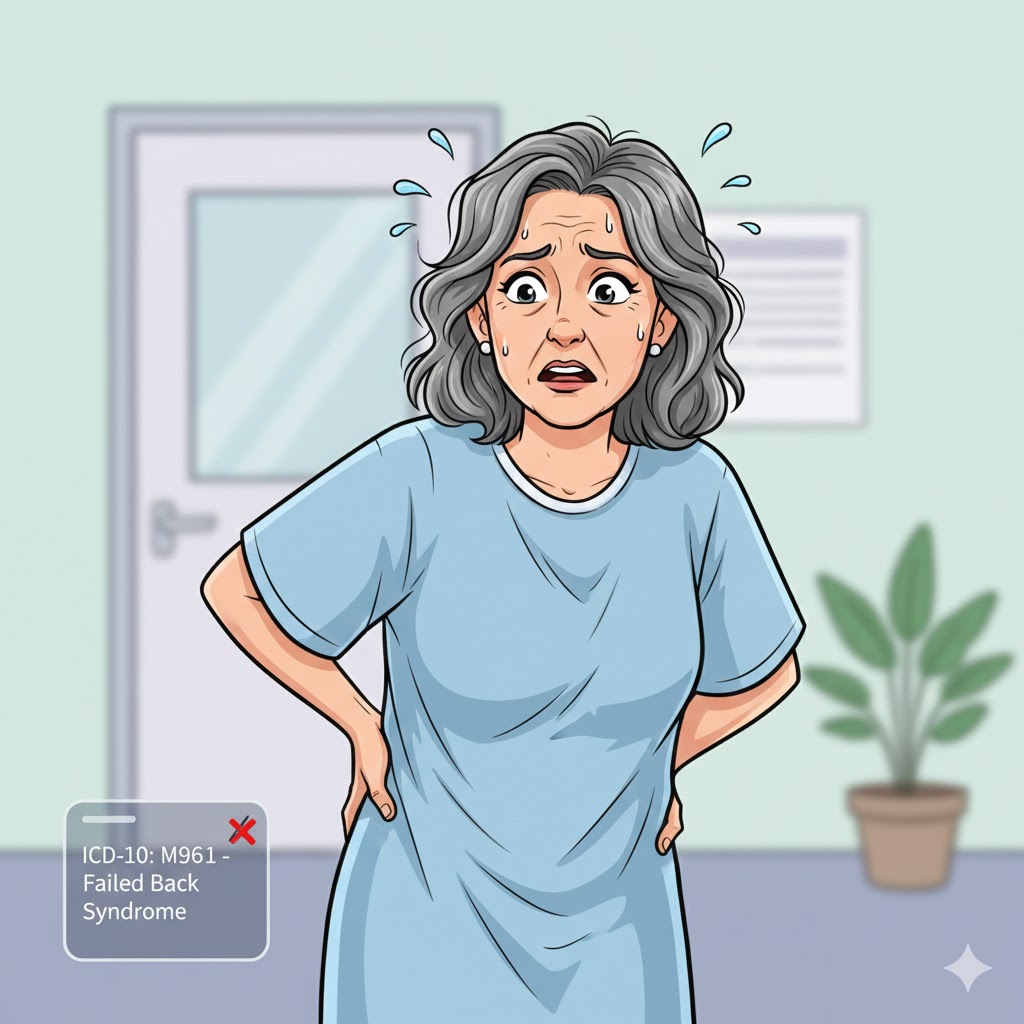
To understand how common these surgical failures became, you only need to look at the medical coding we use every day. There is actually a specific diagnosis codeICD-10: M96.1dedicated entirely to "Postlaminectomy Syndrome," or what we more commonly call Failed Back Syndrome. Think about that: the problem of patients returning to the same surgeons with the same pain (or worse) became so widespread that the medical industry had to create a permanent "label" for it. Its a category for people whose surgery didn’t just fail to help, but actually left them with chronic, structural issues.
Follow the Money: Why Medicare Stepped In
You can tell a lot about the effectiveness of a procedure by looking at who is willing to pay for it. For years, the "standard" was to see a shadow on an MRI and schedule a laminectomy, a discectomy, or a fusion.
But the data finally caught up. Medicare and private insurers have drastically reduced reimbursements for these routine procedures because the outcomes simply didn’t justify the cost or the risk. When the government stops paying top dollar for a surgery, its a loud signal that the "fix" wasn’t working as advertised. The "business" of back surgery is shrinking because the "science" of back surgery failed to deliver for the average patient.
Modern Back Care Isnt About "The Knife"
The traditional back surgeon who just "cleans out" discs is nearly extinct. Todays top specialists have pivoted toward incredibly precise, minimally invasive work, or better yet, avoiding the OR entirely.
My goal for you is to avoid ever having ICD-10: M96.1 written on your chart. We focus on:
- Neuromodulation: Using technology to "reset" how your brain perceives pain.
- Physical Rehabilitation: Strengthening the structures that actually support your weight.
- Realistic Expectations: Understanding that a disc bulge is often a normal part of aging, not a mechanical "error" that needs to be deleted.
Lets Get Real
If I tell you that you don’t need surgery, it isn’t because I’m ignoring your painits because Ive seen what happens when we try to take the "easy" way out with a surgeon. The "fix" isn’t in the operating room; its in the work we do right here in primary care to keep your spine intact and your life moving.
Shaan Kunwar DO
East County Internal Medicine – Your Doctor’s Office