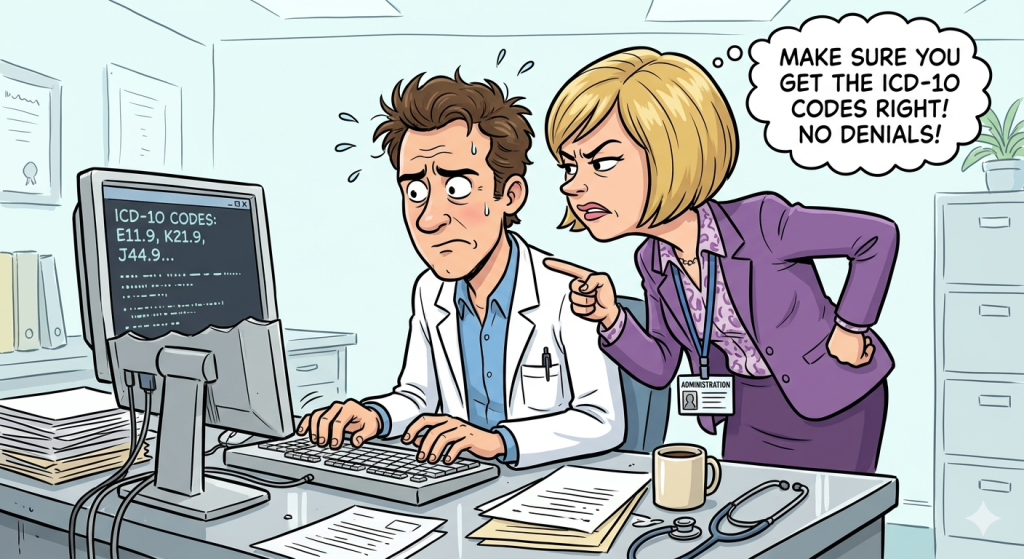
LAKEWOOD RANCH, FL — Step into almost any medical clinic in the United States today, and the scene is identical: a highly trained physician sits with their back to the patient, clicking through endless drop-down menus on a computer screen.
For a decade, this tech-driven isolation has been blamed on general “bureaucracy.” Federal investigations and healthcare reform debates have frequently pointed to the administrative burden of electronic health records (EHRs) as the primary driver of a nationwide doctor burnout epidemic.
But an emerging movement of independent practitioners is blowing the whistle on a deeper, systemic deception. American doctors, they argue, have been systematically misled by their own software vendors—forced to abandon the precise language of medicine to serve as data-entry clerks for the multi-billion-dollar insurance industry.
The Two Languages of Medicine
At the heart of this digital hijacking is a hidden conflict between two profoundly different computerized languages operating behind the clinic walls:
• SNOMED CT: The true language of medicine. Developed by clinicians, this granular database contains over 350,000 highly specific medical concepts. It allows a doctor to document the exact, complex physiological truth of an illness.
• ICD-10: The language of insurance. Maintained by administrative bodies, this rigid classification system exists primarily to bucket illnesses into generalized categories so insurance company computers can process a monetary claim.
“The public believes the doctor is typing out a careful medical narrative to track their healing,” says one Florida-based practitioner utilizing open-source informatics software. “In reality, the software is forcing the doctor to translate that healing into a billing code before they are even allowed to close the chart.”
How Software Misled a Generation
The hijacking began in earnest during the federal rollout of the HITECH Act, which incentivized hospitals and clinics to adopt EHR systems. To ensure health systems could easily collect payments, commercial software giants built their primary “Assessment” and diagnosis search bars to query the administrative ICD-10 database directly, bypassing the clinical SNOMED engine.
As a result, a generation of American medical residents was trained to view patients through the restrictive lens of billable codes rather than clinical descriptions. Doctors began altering their clinical thought processes to match the rigid, sometimes bizarre phrasing required to clear insurance filters and protect hospital revenue.
The software did not adapt to the physician; the physician was forced to adapt to the software.
The Cash-Only Resistance
Now, a growing contingent of direct-care and cash-only practitioners is staging a quiet rebellion. By cutting out third-party health insurance companies entirely, these doctors have discovered a liberating loophole: the mandate to use ICD-10 codes completely evaporates.
Free from the constraints of insurance reimbursement, these clinicians are reconfiguring platforms like OpenEMR to completely hide billing interfaces, allowing them to chart exclusively in the rich, descriptive taxonomy of SNOMED CT.
For the average American patient, this technical shift represents a profound return to traditional care:
• Restored Eye Contact: Doctors spend their time looking at the patient’s face, not hunting for compliant billing phrases to avoid an insurance denial.
• An Uncompromised Record: A patient’s permanent medical file reflects clinical truth rather than an administrative compromise chosen to get a claim paid.
• A Cure for Burnout: By eliminating the artificial documentation burden, physicians are rediscovering the core of their profession.
The crushing digital workload that forces American doctors to spend hours on “pajama time” charting late into the night is not an inherent part of modern science. It is an artificial byproduct of the insurance-billing complex. And as independent clinics are proving, when you change the business model, you restore the medicine.
________________________________________