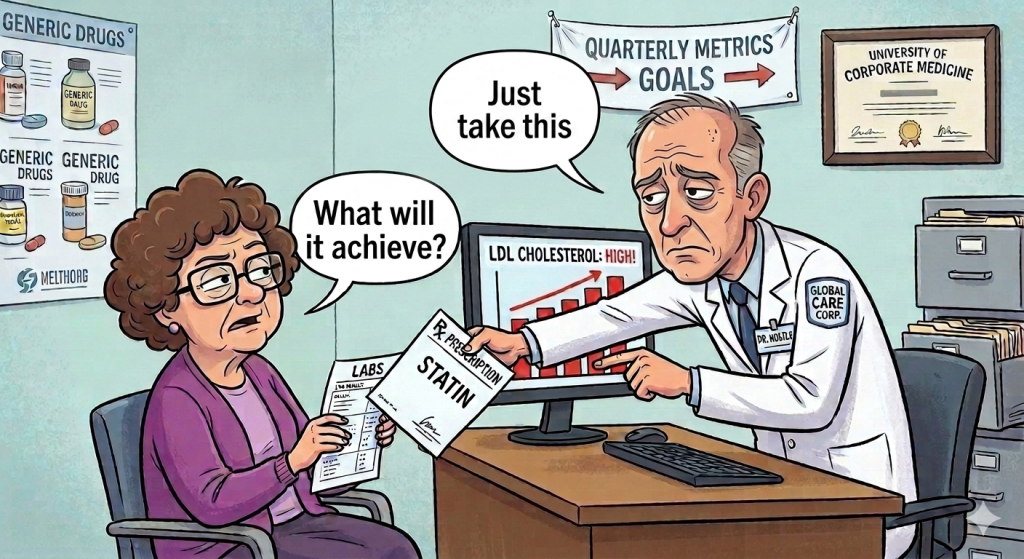
A profound sense of skepticism often arises when patients are told they have high cholesterol. The internet is flooded with articles debating the “statin conspiracy,” claiming these medications are pushed unnecessarily. On the other side, large corporate healthcare networks treat cholesterol management like an automated assembly line. In those high-volume, institutional clinics, the corporate protocol is absolute: if the lab report shows a high LDL number, a statin is automatically prescribed. There is rarely an open discussion or a deep dive into individual patient history. The system simply demands metric compliance.
At East County Internal Medicine, adult primary care centers on a completely different philosophy. Independent medicine views the patient as an intelligent, autonomous partner. The objective of an ethical medical practice is not to issue commands or enforce corporate checklists. Instead, the goal is to dismantle the myths, present the clinical data transparently, and empower individuals to decide whether a medication truly fits their life and long-term health goals.
The Real Mechanism: Moving Beyond the Lab Sheet
The primary reason corporate healthcare models fail patients on this topic is a lack of explanation. When an LDL (low-density lipoprotein) number is elevated, a corporate clinic focuses entirely on forcing that specific metric down to satisfy insurance checkmarks. However, an isolated high number on a blood test does not cause physical harm.
The true purpose of a statin is not to change a number on a piece of paper; it is to reduce the risk of a life-altering heart attack or stroke. Beyond altering circulating blood lipids, statins function deep within the arterial walls. They reduce vascular inflammation and act as a stabilizing agent over existing arterial plaque. This process thickens the fibrous cap over the plaque, making it drastically less likely to rupture—which is the sudden, catastrophic event that actually triggers an acute cardiac incident.
The Illusion of Fast Results
One of the most misleading aspects of standard cholesterol treatment is how quickly the metrics change. When a patient begins a statin, the medication will make the lab numbers look excellent in just a matter of days or weeks. Seeing a dramatic drop in LDL on a follow-up blood test gives a false sense of security.
The clinical reality is that a rapid drop in blood metrics does not grant any immediate health benefit. While the circulating cholesterol drops quickly, the actual physical stabilization of the arterial walls is a slow, biological process. Large-scale, peer-reviewed clinical data indicates that for primary prevention—patients who have never had a heart attack or stroke—it takes an average of 2.5 to 3 years of continuous, daily therapy to achieve a statistically meaningful reduction in cardiovascular risk. Taking a statin for a few months just to correct a lab number provides virtually zero long-term protection. It requires a multi-year strategy, or the intervention is medically hollow.
Tools for True Patient Autonomy
Because independent healthcare models are not bound by the strict time constraints and rigid algorithms of corporate medicine, patients have the freedom to gather comprehensive data before making a choice. Instead of guessing based on basic blood work, several advanced diagnostic tools can provide definitive clarity regarding a patient’s true risk:
Evaluating advanced biomarkers like Apolipoprotein B (ApoB) or high-sensitivity C-reactive protein (hs-CRP) offers a much more precise view of actual particle concentration and active vascular inflammation than a standard lipid panel.
Utilizing a Coronary Calcium Scan (CAC)—a rapid, low-cost imaging test readily accessible to residents in the Bradenton and Lakewood Ranch areas—allows a direct look inside the coronary arteries to detect the actual presence of calcified plaque. A CAC score of zero indicates an incredibly low short-term risk, which completely reshapes the decision-making framework for many individuals.
Committing to aggressive, structured, and long-term modifications to nutrition, daily physical activity, and stress management can serve as a primary therapeutic path. Independent medicine is uniquely structured to support and monitor these non-pharmaceutical strategies with the exact same rigor as a medical prescription.
A Partnership Built on Informed Consent
The human body belongs to the individual, not a pharmaceutical corporation, an insurance company, or a corporate hospital board. Medical care at East County Internal Medicine honors this boundary by delivering objective evidence, discussing realistic timelines, and weighing benefits against potential side effects without judgment or pressure.
Once the complete clinical picture is laid out, the final decision rests entirely in the patient’s hands. For adults in Bradenton, Lakewood Ranch, and throughout Florida who utilize the Patient Telehealth Portal, healthcare is defined as a collaborative partnership built on mutual respect and thorough education.
________________________________________
Shaan Kunwar DO
Eastcountyim.com
941-727-7771